ilex
Ilex verticillata - Winterberry Holly
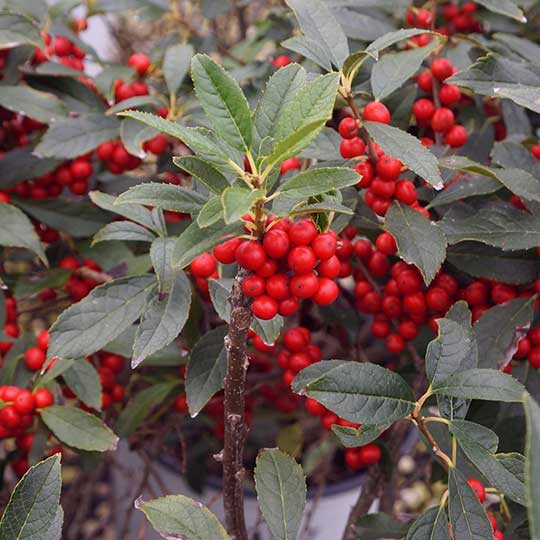
Ilex Verticillata Winterberry Holly: A Deciduous Shrub for Winter Interest
Ilex verticillata winterberry holly, a deciduous species in the Aquifoliaceae family, is a durable woody plant available at our Mundelein nursery. For homeowners in Mettawa or Morton Grove looking to add intense cold-season color and a structural presence to their landscapes, this native species is a functional choice. Its ability to produce abundant crops of bright red berries and its resilience in damp or poorly drained soil make it a steady performer in any North Suburb garden where winter aesthetics and wildlife support are the primary goals.
Performance in Northern Illinois Soil
This species is hardy in our Zone 5b climate and is a representative selection for Midwest rain gardens, pond edges, and low-lying residential borders. While many ornamental shrubs struggle with the heavy, unyielding clay found throughout the region, the Ilex verticillata winterberry holly grows well in it, provided the site is not overly alkaline. It is successful in the moist, shaded landscapes of Morton Grove, where its root system can handle the seasonal saturation of early spring. In Mettawa, these plants act as a durable architectural staple, emerging with dark green, lance-shaped leaves that provide a dense, clean backdrop for the garden throughout the summer months.
Size, Spacing, and Growth Habit
Planning for the mounded and multi-stemmed nature of this shrub ensures it provides the intended visual mass without encroaching on walkways or requiring excessive pruning to stay within its designated bounds:
-
Average Height: Depending on the cultivar, height can vary from compact types at 3 to 5 feet tall to the straight species which can reach 10 to 12 feet tall.
-
Average Width: Most mature specimens develop a footprint spanning 5 to 12 feet wide, often forming a rounded or upright-oval silhouette.
-
Spacing Requirements: To create a solid fruiting hedge or a continuous woodland border, space plants 4 to 6 feet apart. For individual specimen planting, leave a gap of at least 6 feet from the mature width of neighboring shrubs to ensure airflow and to provide room for the maintenance of the root zone.
Characteristics of Winterberry Holly
In the North Suburbs, this group of shrubs serves as a source of seasonal transitions and ecological support, addressing several specific gardening requirements:
-
Persistent Winter Berries: The most notable trait of this plant is the production of dense clusters of bright red (or occasionally gold) berries. Unlike evergreen hollies, this species drops its leaves in late autumn, leaving the berries fully exposed on the bare branches. This characteristic is commonly utilized to provide high-impact color against the winter snow.
-
Dioecious Reproductive System: These plants are either male or female. Only the female plants produce berries, and they require a male pollinator nearby to ensure fruit set. This is a functional necessity to keep in mind during the landscape planning phase.
-
Tolerance for Saturated Soil: It is a practical choice for "problem" areas with poor drainage or standing water where other shrubs might suffer from root rot.
-
Wildlife and Pollinator Value: The small white flowers in spring provide nectar for bees. In the winter, the berries serve as a critical food source for over 40 species of birds, including Eastern Bluebirds and Cedar Waxwings.
-
Ornamental Cut Branches: Because the berries are persistent and cling tightly to the stems, the branches are commonly used in winter floral arrangements and outdoor holiday containers.
Planting and Maintenance Advice
To ensure your shrub remains healthy and produces a prolific crop of berries each year, follow these straightforward care steps:
-
Light Exposure: Winterberry holly is adaptable to light. While it grows well in partial shade, full sun (at least 6 hours) is required to achieve the highest density of fruit and the best mounded habit.
-
The "Male-to-Female" Ratio: To ensure pollination, you should plant one male variety for every 6 to 10 female plants. The male must be a variety that blooms at the same time as the female. For example, 'Jim Dandy' is the early-blooming male for 'Berry Nice', while 'Southern Gentleman' is the late-blooming male for 'Winter Red'.
-
Soil pH and Acidity: While it is adaptable to clay, it prefers slightly acidic to neutral soils. In the alkaline clay often found in Lake County, the leaves may show signs of chlorosis (yellowing). Amending the soil with organic matter or leaf mold is a practical way to manage this.
-
Pruning Cycles: This shrub requires very little pruning to maintain its shape. If you wish to thin out the plant or remove old wood, do so in early spring before new growth begins. Be aware that heavy pruning in the spring may reduce the number of flowers and, subsequently, the berry crop for that year.
-
Consistent Moisture: While it can handle saturation, it does not tolerate extreme drought well. During the dry weeks of August, supplemental irrigation is a functional necessity to ensure the developing berries do not drop prematurely.
Frequently Asked Questions (Lake County Edition)
Why doesn't my plant have any berries?
The most likely reason is the lack of a male pollinator nearby or a male that does not bloom at the same time as the female. It is also possible the plant is still too young or that a late spring frost damaged the blossoms.
Are the berries poisonous?
Like most hollies, the berries are not for human consumption and can cause stomach upset if ingested. However, they are highly valued by birds and other wildlife as a winter survival food.
Visit The Country Bumpkin Garden Center
We are located at the corner of Gilmer Rd & Hawley St in Mundelein. Stop by to see the various cultivars of Ilex verticillata winterberry holly in person—from the classic 'Winter Red' to compact 'Berry Poppins'—and find the right fit for your landscape. We are a local resource for gardeners across Mundelein, Morton Grove, and the surrounding communities.
Call (847) 566-2176 or Send a Message to check current availability.
Varieties: Berry Poppin, Mr Poppin
See: Shrubs and Roses
Category: Sun Perennials - Sun Plants - Sunny Plants - Shrubs - Deciduous Shrubs - Winterberry near me - Ilex - Holly